
Simulated plane crash at Seville Airport with 170 personnel
Topics Regional Government of Andalusia
The Junta de Andalucía has assessed this Tuesday the response of the emergency services to a plane crash with a drill at Seville Airport, in which 170 personnel from 18 organisations and 58 extras took part.
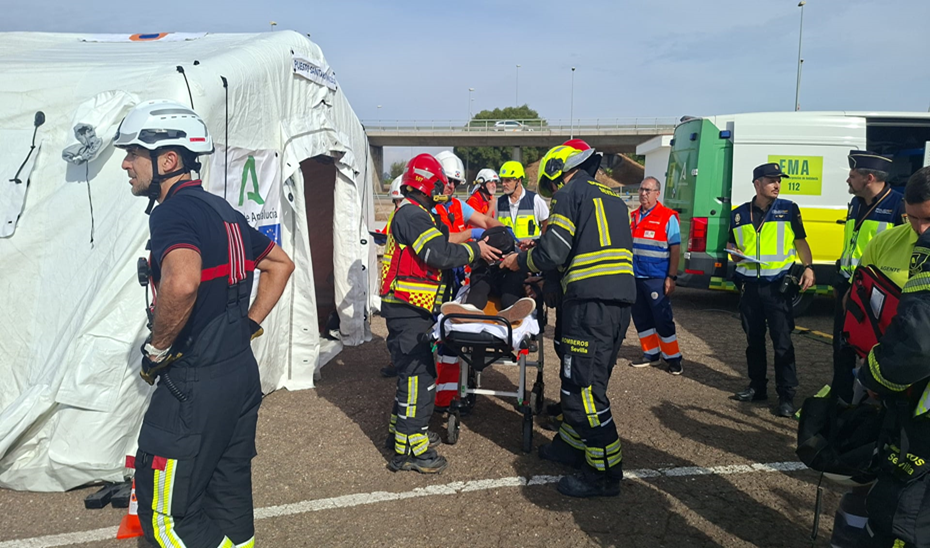
The exercise recreated the fire of a commercial aircraft during refuelling and passenger boarding operations. The aircraft, a twin-engine plane that was scheduled to take off for Gran Canaria, was parked on the apron when a fuel spill caused a fire and structural damage to the fuselage.
A simulated casualty toll
In the simulated scenario there were 35 passengers and four crew members on board. The exercise set an initial toll of two dead, twelve very seriously injured, nine seriously injured and sixteen slightly injured, in addition to the subsequent death of one of the critically injured.
The severity of the simulated accident led to the activation of the Seville Airport Self-Protection Plan, in its General Aeronautical Emergency phase, and the Territorial Civil Protection Emergency Plan of Andalucía (PTEAnd). The aim was to check the coordination and response capacity of the organisations involved.
The hospitals, also put to the test
The response went beyond the airport. The city's three public hospitals, Virgen del Rocío, Virgen Macarena and Virgen de Valme, rehearsed the activation of their disaster plan to receive the injured. This protocol allows a health centre to reorganise its resources to treat a large number of casualties in a short time.
The airport firefighting services and the Seville City Council Fire Brigade intervened to control the fire and facilitate the rescue and evacuation of the occupants. The Andalucía Emergency Group (GREA) deployed an Advanced Command Post (PMA) to coordinate the emergency services.
The professionals of the 061 Health Emergency Centre and the Andalusian Health Service (SAS) treated the victims at an Advanced Medical Post, where they were triaged by severity, given first aid and their transfer to hospitals was organised.
Support for relatives
The exercise also put into practice the procedures for supporting the victims of civil aviation accidents and their relatives. A crisis room, a room for uninjured passengers and facilities for the reception and assistance of relatives were set up. Professionals from the Psychological Intervention Group in Emergencies and Disasters (GIPED) worked in this operation, together with airport teams, airline staff and other specialised services.
To add greater realism, 58 extras from the Faculty of Nursing, the SAMU School and the Faculty of Psychology played injured and uninjured passengers and their relatives.
Who took part
The exercise involved Aena and Seville Airport; the Andalucía Emergency Agency, through EMA 112 and EMA GREA; the 061 Health Emergency Centre; the SAS, with the three hospitals; the Seville City Council Fire Brigade; the Guardia Civil; the Policía Nacional; the Policía Local; the Policía Nacional unit assigned to the Autonomous Community; the Institute of Legal Medicine; Protección Civil; the National Emergency Radio Network (REMER); the Official College of Psychology; the airline Binter and ground handling companies.
The delegate of the Government of the Junta de Andalucía in Seville, Ricardo Sánchez, acted as executive director of the Plan. The day included the evaluation of the actions in each scenario to identify areas for improvement.