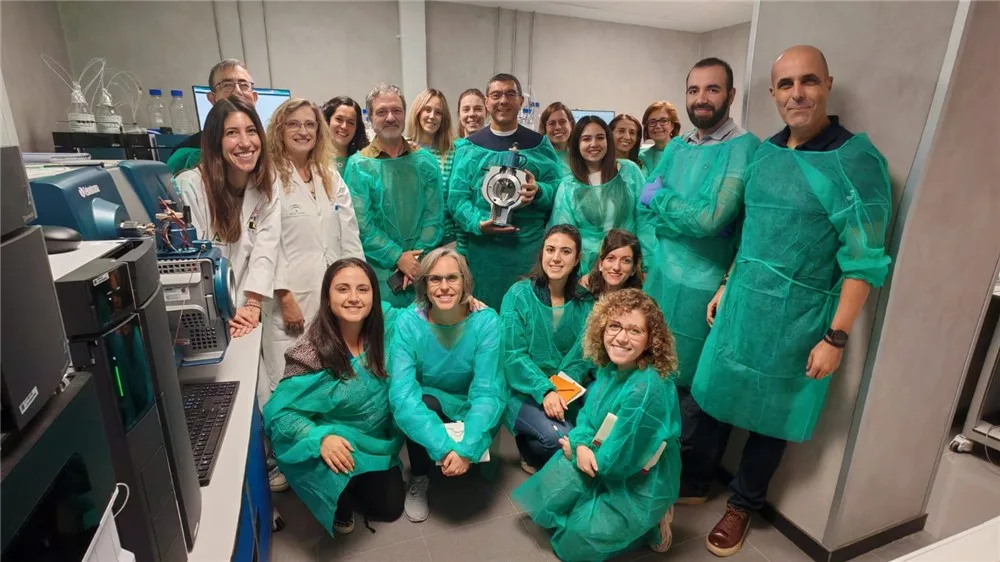
Professionals from newborn screening laboratories in different countries have spent four days at the Hospital Materno Infantil de Málaga to share how congenital diseases are detected in newborns. The event, the International Academy of Newborn Screening, combined theoretical sessions, analysis of clinical cases and practical work in the hospital's own laboratory.
Newborn screening, known as the heel prick test, makes it possible to identify congenital, metabolic, endocrine and genetic diseases before the first symptoms appear. Detecting them in the first days of life makes it easier to start treatment and follow-up earlier, which can prevent serious complications and improve the prognosis of the minors.
The scientific programme has addressed the organisation of screening programmes in Spain and Italy, laboratory techniques, the interpretation of results, second-tier tests and diagnostic confirmation procedures. There have also been sessions on quality control, sample traceability, information systems and communication with birth centres and families.
Among the diseases studied are cystic fibrosis, congenital hypothyroidism, congenital adrenal hyperplasia, galactosemia, spinal muscular atrophy, severe combined immunodeficiencies and various inherited metabolic diseases. In addition, new pathologies that could be incorporated into early detection programmes have been discussed.
The activity has been organised by the Laboratory service of the
Hospital Regional Universitario de Málaga, the Asociación Española para el Estudio de los Errores Congénitos del Metabolismo (AECOM) and the Sociedad Italiana para el Estudio de las Enfermedades Metabólicas Hereditarias y el Cribado Neonatal (SIMMESN), according to the Servicio Andaluz de Salud (SAS).
Specialists such as José Cocho, Hugo Rocha, Giancarlo La Marca, Cristiano Rizzo, Yolanda González and Ana Argudo have taken part in the sessions, together with professionals from the Materno Infantil such as Raquel Yahyaoui, María José Aguilar and María Mayor.
The head of the Laboratory of the Hospital Materno Infantil, Raquel Yahyaoui, has stated that «newborn screening is one of the most effective prevention tools in childhood, because it allows us to detect diseases that can go unnoticed at birth and act before they cause irreversible damage».