Researchers from Huelva and Seville develop a water-free emulsion that stores and transports cold for industry and the cold chain.
AndalucíaYa newsroom
·
Photo: Junta de Andalucía · Portavoz
A team from the universities of Huelva and Seville has formulated a liquid from citrus peels that, in addition to transporting cold, is capable of storing it and releasing it when the temperature changes. The mixture works in an approximate range of between -85 and +5 degrees Celsius and, in the tests, it managed to store and move up to 2.4 times more cold than some common refrigerants occupying the same space.
The material can be used in two ways: circulating through pipes and heat exchangers, like other refrigerant fluids, or stationary, as a thermal accumulator similar to an ice pack but designed for much lower temperatures. That makes it useful for industrial freezing, preservation and transport of food, medicines or biological samples, and for very low-temperature refrigeration systems.
Without water and with three ingredients
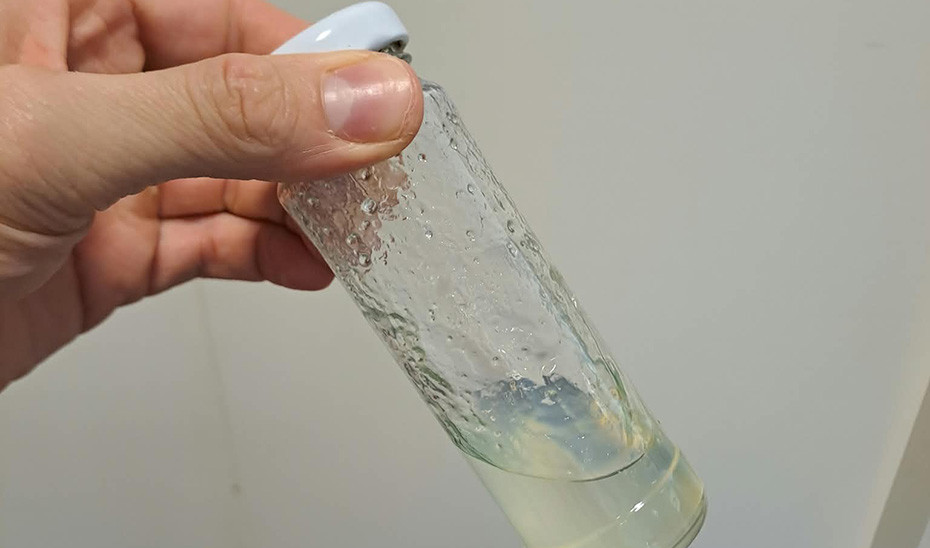
The main novelty is that the emulsion contains no water, which allows it to work at temperatures far below the glycol-water mixtures or brines commonly used in refrigeration installations. The compound combines PEG400, which absorbs and releases energy when changing state; D-limonene, obtained from citrus peel, which replaces water; and silica nanoparticles, which hold the mixture together and prevent the droplets from separating when freezing and thawing.
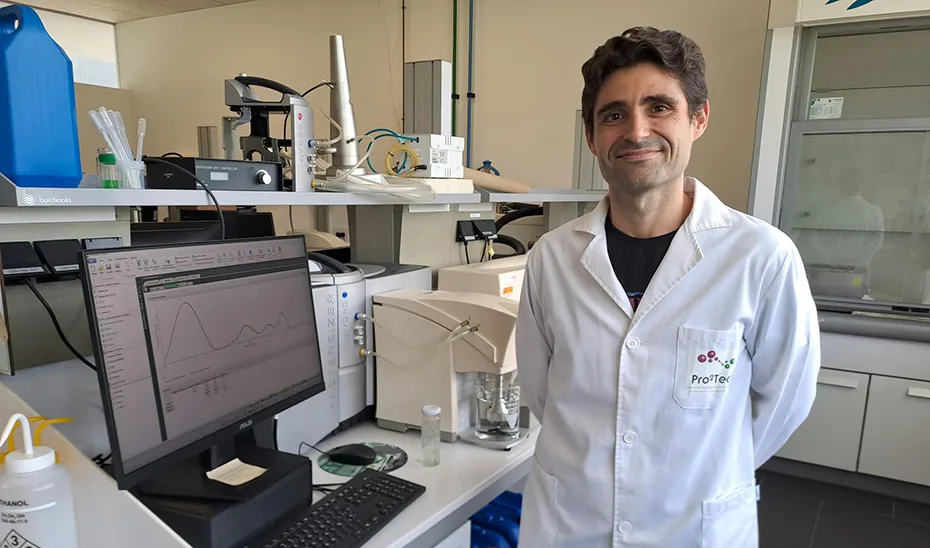
«However, adding too much silica makes the liquid more viscous and harder to move through pipes. That is why the challenge lies in fine-tuning the recipe,» explains University of Huelva researcher Adrián Tenorio Alfonso.
The work, from the Pro2TecS centre of the University of Huelva together with the Department of Chemical Engineering of the University of Seville, has been published in the journal International Journal of Refrigeration and has received funding from the Regional Ministry of University, Industry, Energy and Innovation of the Junta de Andalucía, the Ministry of Science, Universities and the State Research Agency, as well as ERDF funds.
For now it is a proof of concept: the team has formulated the material, studied its thermal and flow properties and compared it with common refrigerants through laboratory tests and mathematical calculations. The next step is to test it in systems closer to a real installation, with compressors, valves, pipes and heat exchangers, and to move towards a simpler preparation that facilitates its possible industrial development.
Share this story
Breaking news from News, on your phone
An alert only when something can't wait. Free, no account needed.
On iPhone, alerts only arrive if you first add AndalucíaYa to your Home Screen.
How to do it, step by step
This browser can't receive alerts. Try another one, such as Chrome or Safari.
You've blocked alerts from AndalucíaYa in this browser. You can turn them back on in its settings.
How to do it, step by step