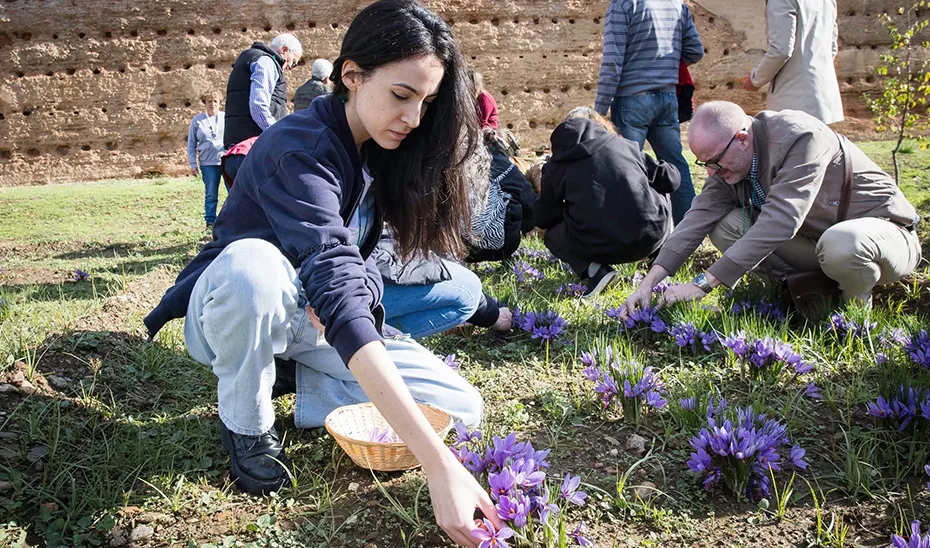
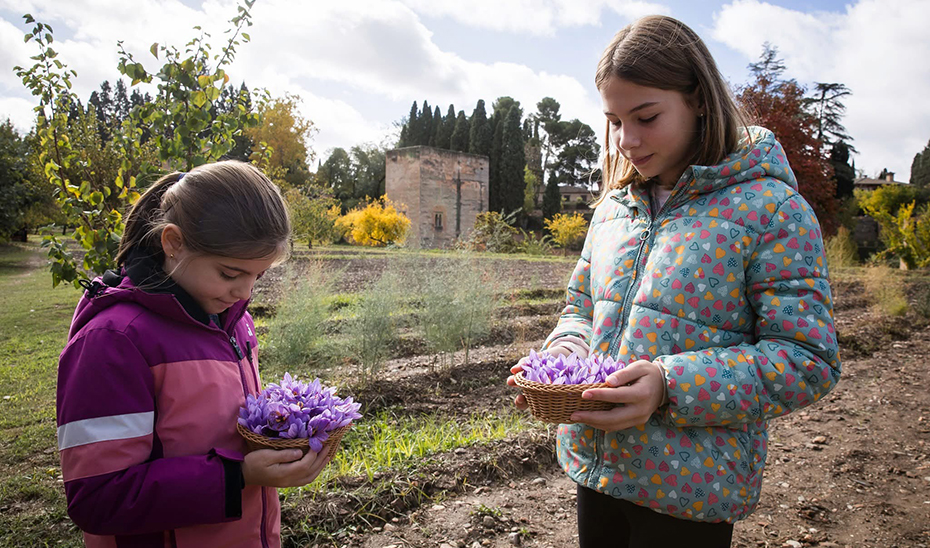
The Patronato de la Alhambra y Generalife organises guided tours on November 14 and 15 to learn about saffron cultivation in its gardens.
AndalucíaYa newsroom
·
Photo: Junta de Andalucía · Portavoz
Saffron flowering lasts barely ten days a year. With the first autumn rains, this violet-petalled flower reappears among the crops of the Huertas del Generalife, in the Alhambra, and the Patronato de la Alhambra y Generalife has organised guided visits to see it on November 14 and 15.
The activity takes place in the Huerta Grande del Generalife and shows the cultivation, harvesting and drying of this spice. Inside, each flower holds three fine red stigmas that, after a meticulous harvesting and drying process, become one of the most prized and valuable spices in the world.
From monda to drying
Those who take part will see first-hand work that demands patience, skill and precision. The flowers are picked with special care to preserve the stigmas, which are then separated by hand in an operation known as monda. Then comes drying, a fundamental phase for preserving the aromatic properties and the characteristic colour of the spice. It is a craft process that keeps much of the technique used for generations.
Saffron cultivation has a long history linked to Mediterranean agriculture. Originally from the eastern end of the Mediterranean and southwest Asia, it reached notable importance in al-Ándalus from the 11th century onwards. Its use spread far beyond the kitchen, where it was prized for its aroma, flavour and ability to colour food. It was also used in medicinal and cosmetic preparations.
An agricultural landscape next to the palaces
The huertas are one of the most representative testimonies of that past. Their origin dates back to the Andalusian period, when the use of water, irrigation systems and the distribution of crops made it possible to develop intense agricultural activity on the slopes of the Generalife. The continuity of these uses has helped preserve a historical landscape in which architecture, vegetation and traditional farm work coexist.
The proposal allows visitors to approach a part of the history of the Generalife that usually remains in the background compared with the monumentality of its palaces, courtyards and gardens. Alongside these ornamental spaces, the site preserves an agricultural tradition that for centuries was linked to the supply and daily life of its inhabitants.
The Patronato de la Alhambra y Generalife depends on the Consejería de Cultura, Patrimonio Histórico y Deporte of the Junta de Andalucía, as the Junta has indicated.
Share this story
Breaking news from News, on your phone
An alert only when something can't wait. Free, no account needed.
On iPhone, alerts only arrive if you first add AndalucíaYa to your Home Screen.
How to do it, step by step
This browser can't receive alerts. Try another one, such as Chrome or Safari.
You've blocked alerts from AndalucíaYa in this browser. You can turn them back on in its settings.
How to do it, step by step