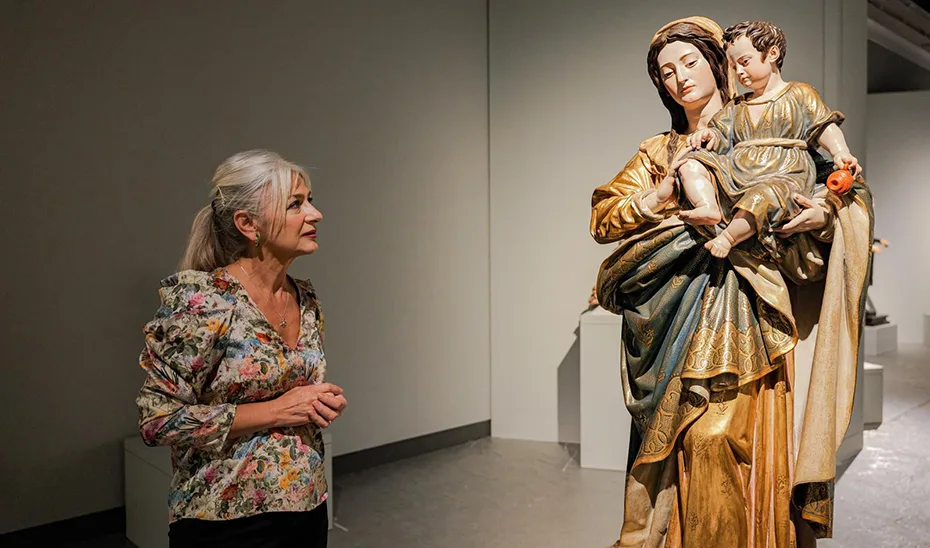
Twelve works by Juan de Mesa recover their original colour for the Seville exhibition
The Museo de Bellas Artes de Sevilla has restored twelve carvings by the Cordoban sculptor ahead of the exhibition opening on November 18.
AndalucíaYa newsroom
·
·
Photo: Junta de Andalucía · Portavoz
Update of November 19, 08:04
The exhibition is now open to the public. The Regional Minister of Culture, Historical Heritage and Sport, Patricia del Pozo, has inaugurated the show at the Museo de Bellas Artes de Sevilla, which will remain open until March 7.
Del Pozo described the exhibition as "the most ambitious show assembled to date" of the work of Juan de Mesa and thanked the lenders from the more than thirty participating institutions for their collaboration. The show is organized into eight sections and has been curated by Ignacio Cano Rivero, Ignacio Hermoso Romero and Valme Muñoz Rubio.
The release also details a program of educational activities, with guided tours and a lecture series 'Mirar un cuadro' on Sundays November 22, December 20, January 17 and February 14, at 12:00 in room 13 of the museum, with free entry until full capacity is reached.
Twelve carvings by Juan de Mesa once again show their original colour and brightness. The Museo de Bellas Artes de Sevilla has completed in recent months the restoration and conservation work on these works on the occasion of the exhibition dedicated to the Cordoban sculptor, as announced by the Junta de Andalucía.
Among the pieces worked on are the «Virgen con el Niño» (or «Virgen de las Cuevas») and the «San Juan Bautista», both from 1623 and owned by the museum, and the Cristo de la Conversión del Buen Ladrón, from the hermandad de Montserrat. The work on the first two, sponsored by the Asociación de Amigos del Museo de Bellas Artes de Sevilla, has revealed that they are made of cedar wood and that the Virgen retains its original polychromy. The Niño Jesús accompanying her carries a small búcaro with flowers, an element linked to the pottery tradition of the vega de Triana.
From El Puerto to Montilla
The rest of the restored works come from parishes, hermandades and religious orders in several Andalusian provinces. Such is the case of the «San Ignacio de Loyola» (1622), from the parish of San Francisco de El Puerto de Santa María (Cádiz); the «San Juan de Sahagún» (around 1622-1623), from the church of San Agustín de Montilla (Córdoba); and the «San Carlos Borromeo» (1618), from the church of the hospital de Nuestra Señora de la Paz, in Seville.
Work has also been carried out on the «San Eloy» (around 1618), from the Seville parish of Santa Cruz; the «San Ramón Nonato» (1626), held by the museum itself; the «Inmaculada» (around 1621-1623), from Omnium Sanctorum; the «San Antonio de Padua con el Niño» (1620), from the ermita de Setefilla de Lora del Río; the «Cabeza de San Juan Bautista» (1625), from the Catedral de Sevilla; and the Virgen de la Misericordia (around 1611), from the Fundación Antezana.
The councillor for Culture, Historical Heritage and Sport, Patricia del Pozo, has stated that the exhibition «has given us the opportunity to carry out comprehensive work or conservation treatment on a dozen works by the artist, most of them belonging to parishes, hermandades and religious orders».
The exhibition brings together 47 pieces
The twelve works are part of the exhibition «Juan de Mesa (1583-1627)», which opens on 18 November and traces the sculptor's evolution and the variety of themes in his output. The exhibition brings together a total of 47 works and will occupy room five and the temporary exhibition room of the museum. In the transept of the old church of the convento de la Merced, three crucifixes will be displayed: the Cristo de la Vera Cruz, from Las Cabezas de San Juan; the Cristo de la Buena Muerte, from los Estudiantes; and the Cristo de la Conversión, from Montserrat. The temporary exhibition room will close with the Virgen de las Angustias de Córdoba, Mesa's final work.
The pieces come from hermandades such as Montserrat, los Estudiantes, el Amor and el Museo, from Seville itself, and from las Angustias (Córdoba), la Vera Cruz (Las Cabezas de San Juan), Setefilla (Lora del Río) and Nuestra Señora de los Dolores (Santa Olalla de Cala, Huelva). The Universidad de Sevilla, the Museo de Bellas Artes de Córdoba, the Museo Nacional de Escultura de Valladolid and the Museo Frederic Marès de Barcelona are collaborating.
To visit the exhibition, go to the Museo de Bellas Artes de Sevilla from 18 November.